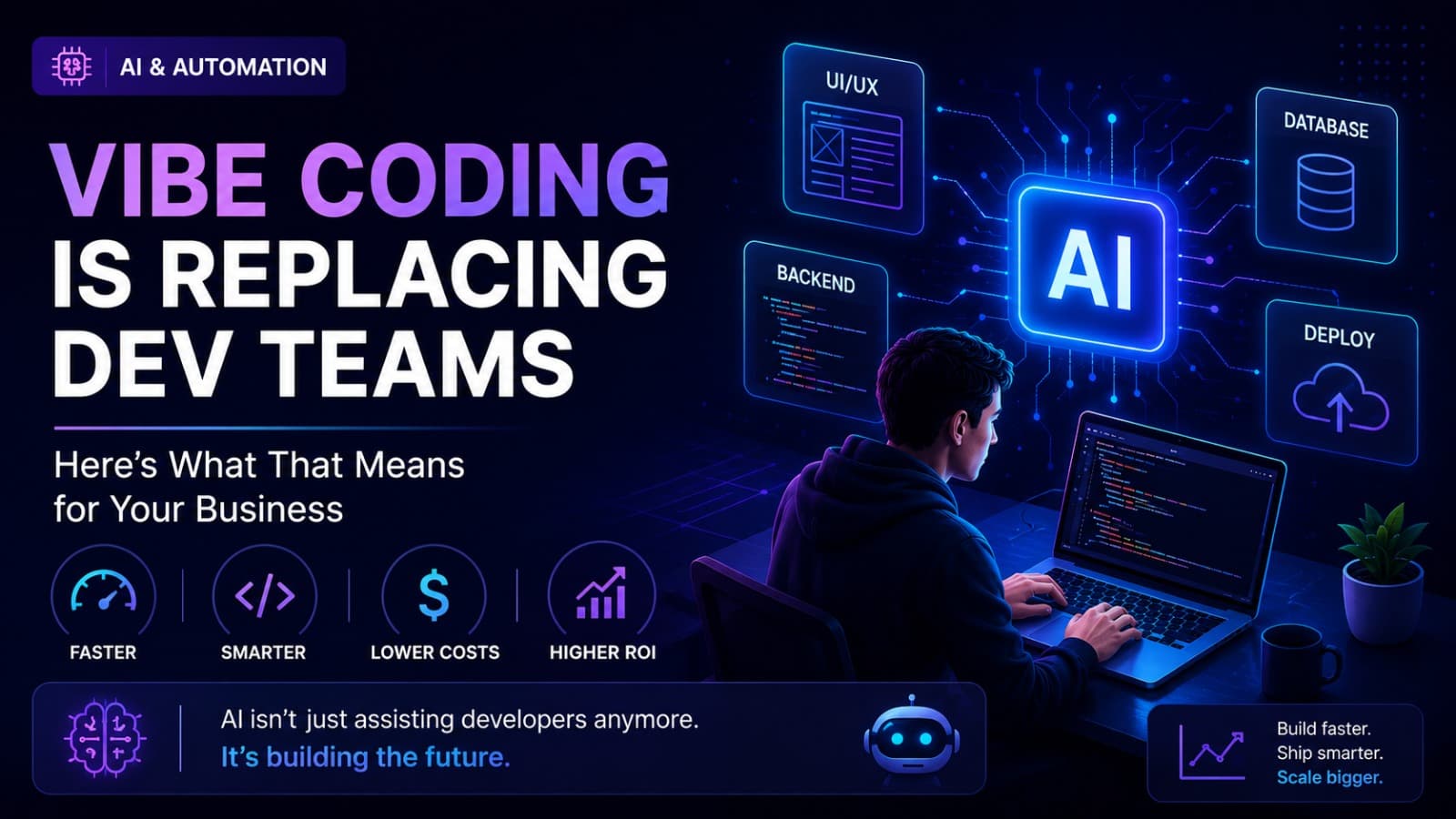
Not long ago, building software meant hiring a team of developers, writing detailed briefs, sitting through sprint reviews, and waiting weeks for a feature to ship. Today, a founder with no coding background can describe what they want in plain English and watch it appear on screen in minutes.
That's vibe coding. And it's not a trend. It's a fundamental shift in how software gets built, and what it means for your business could be enormous.
What Exactly Is Vibe Coding?
The term was coined by AI researcher Andrej Karpathy, who described it as a new way of building software where you "fully give in to the vibes" by describing what you want in natural language and letting AI coding tools handle the rest.
Instead of writing line-by-line logic, you prompt. Instead of debugging syntax, you describe the problem. Instead of months of development, you ship in days.
AI coding tools like Cursor, GitHub Copilot, Replit Agent, and Claude Code have made this a real workflow, not just a concept. They read your intent, generate working code, test it, fix errors, and iterate. You stay in the driver's seat without touching a single semicolon.
For non-technical founders, product managers, and business owners, this is the most exciting shift in software development since the cloud.
Why Vibe Coding Is Taking Over Dev Teams
The rise of vibe coding isn't happening in isolation. It's the visible result of years of progress in software automation: large language models that understand context, AI systems that can hold state across an entire codebase, and tools that turn plain-English instructions into deployable applications.
1. Speed is incomparable
A feature that once took a two-week sprint can be prototyped in an afternoon. Businesses that move fast win, and vibe coding compresses timelines in ways that weren't possible before.
2. The cost curve has collapsed
Hiring a mid-level developer in the UK or US costs upwards of GBP 60,000 to GBP 90,000 per year. AI coding tools with similar output run at a fraction of that. For early-stage businesses or lean teams, this changes the entire economics of building software.
3. Non-technical people can build
Marketers, operators, and founders are now shipping internal tools, automations, and MVPs without writing a single line of code using the same AI coding tools that developers use, just with natural language instead of syntax.
4. Iteration is continuous
Because there's no handoff between describe and build, you can test ideas, throw them away, and try again within the same session. The feedback loop is near-instant.
Will AI Replace Developers? The Honest Answer
This is the question dominating tech circles right now, and the honest answer is: not entirely, but the role is changing fast.
For routine, well-defined tasks such as building CRUD apps, writing boilerplate code, creating API integrations, and generating tests, AI is already as capable as a junior-to-mid-level developer. In many cases, it's faster and more consistent.
1. Deep architectural thinking
Complex and legacy systems still need architectural judgment across code, teams, business constraints, and long-term maintainability.
2. Security-critical decisions
High-risk systems need review from people with deep context, especially when customer data, payments, or sensitive operations are involved.
3. Novel engineering problems
AI is strongest when patterns already exist. New problems with no precedent still require expert reasoning.
4. Interpersonal judgment
Stakeholders do not always ask for what they actually need. Understanding that gap remains a human skill.
So will AI replace developers entirely? No. But fewer developers will be needed to achieve the same output. Teams that once required six engineers may now operate effectively with two, supported by AI coding tools doing the heavy lifting on implementation.
For businesses, this means you don't need to wait until you can afford a full dev team to start building. And for existing teams, it means your developers can work at a level of leverage they've never had before.
What This Means for Your Business Right Now
Whether you're a startup, a scaling company, or an established enterprise, the future of business software is being rewritten by vibe coding. Here's what you need to pay attention to:
1. Your build cost just got cheaper
If you've been putting off building an internal tool, a client portal, a custom automation, or a product feature because it was too expensive to develop, that excuse is disappearing. Businesses that understand this are going to outmanoeuvre competitors who are still waiting for the quarterly dev sprint.
2. Speed of execution is now a competitive moat
Vibe coding enables rapid prototyping, instant iteration, and faster time-to-market. The businesses that learn to operate at this speed will build compounding advantages.
3. Your tech strategy needs a rethink
Software automation was once a cost-saving measure. Now it's a growth lever. The question is not just how to automate to save time, but what you could build if building was cheap and fast.
4. Hiring signals are shifting
If you're planning to hire developers in 2026, the brief has changed. You need people who can think architecturally, prompt intelligently, review AI output critically, and move fast.
5. The non-technical founder's moment
The ability to describe a product, have AI build a working version, test it with real users, and iterate without a single hire changes the entire calculus of entrepreneurship.
The Risks You Need to Know
Vibe coding is powerful, but it comes with real risks that businesses need to manage carefully.
1. Security vulnerabilities
AI-generated code isn't always secure. If your product handles customer data, financial transactions, or sensitive information, you need a developer or security audit reviewing what AI produces before it goes live.
2. Technical debt at speed
Because vibe coding is fast, it's easy to pile on features without a coherent architecture. What's fast to build can be painful to maintain.
3. Over-reliance without understanding
If no one on your team understands what's being built, you're flying blind. You don't need to write code, but you do need to understand what your software is doing at a high level.
4. Intellectual property ambiguity
The legal landscape around AI-generated code is still forming. If your business builds proprietary software, get legal clarity on how your tools handle training data and code ownership.
How Kynosi Helps Businesses Navigate This Shift
The rise of vibe coding and software automation doesn't mean businesses should go it alone. The tools are democratising, but the strategy still matters enormously.
At Kynosi, we help businesses understand where AI fits in their growth strategy, from identifying which workflows to automate first, to building AI-assisted marketing systems that run continuously in the background.
The future of business isn't about hiring more people or spending more on software. It's about building smarter systems that work around the clock, and knowing how to use the right tools at the right time.
Final Thought: Vibe Coding Isn't the End of Building. It's the Beginning.
The businesses that treat vibe coding as a threat are looking at it wrong. The ones that treat it as a lever are going to build things their competitors haven't even imagined yet.
Software automation and AI coding tools are compressing the gap between idea and reality. The future of business belongs to the teams who learn to close that gap faster than everyone else.
The question isn't whether AI will replace your dev team. The question is: what are you going to build now that building is finally within reach?
Vibe coding is changing the economics, speed, and structure of software delivery. Businesses that pair AI coding tools with clear strategy, strong review, and disciplined execution will move faster than teams still treating software as a slow, expensive bottleneck.