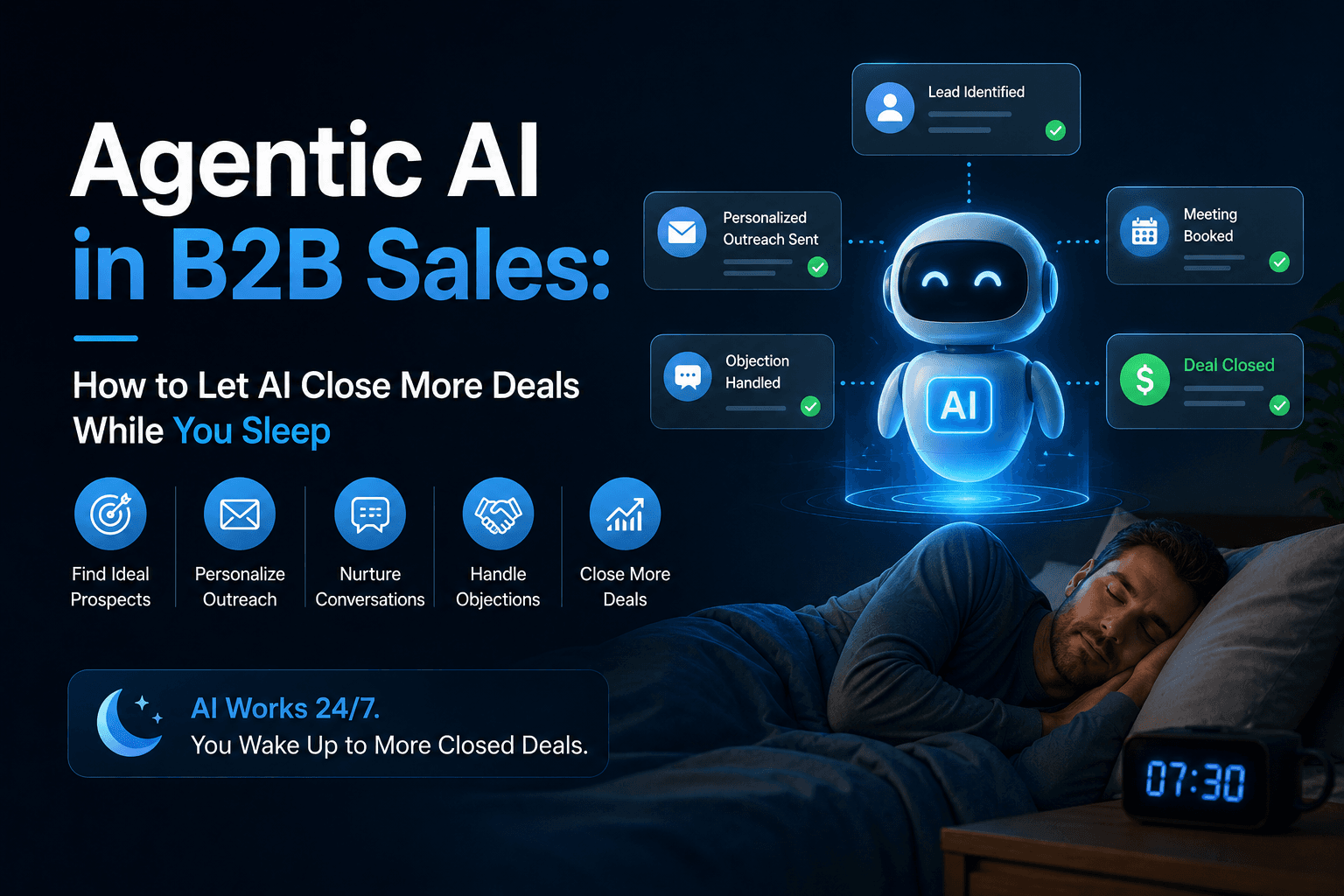
The best salespeople close deals. The problem is they can only work so many hours, handle so many conversations, and follow up so many times before the human bottleneck becomes the growth bottleneck.
Agentic AI changes that equation.
Not AI that helps you write a cold email faster. Not a chatbot that answers FAQs on your website. Agentic AI in B2B sales is something categorically different — autonomous AI systems that research prospects, personalise outreach, qualify leads, follow up across multiple touchpoints, update your CRM, and hand off warm, sales-ready conversations to your human team — without being prompted to do so at every step.
This is AI lead generation at a scale and consistency that no human team can match. And the B2B companies that are deploying it now are opening a gap that will be very difficult for their competitors to close.
What Is Agentic AI — And Why Does It Matter for B2B Sales?
To understand why agentic AI is different from the AI tools most sales teams are already using, it helps to understand what 'agentic' actually means.
Traditional AI tools in sales are reactive. You prompt them, they respond. You ask for a draft email, they write one. The human is still the orchestrator — AI is just a faster assistant.
Agentic AI is proactive. It pursues goals autonomously, making decisions, taking actions, and adjusting its approach based on what it learns — without requiring a human to drive every step. An agentic AI system doesn't wait to be told to follow up with a lead who opened an email twice but didn't reply. It follows up, with a relevant message, at the right time, automatically.
In B2B sales, where the biggest killers of revenue are speed-to-response, follow-up consistency, and personalisation at scale, agentic AI addresses each of these systematically and simultaneously.
The B2B Sales Problems Agentic AI Was Built to Solve
Before exploring what agentic AI can do, it's worth naming the problems it's solving — because these are problems every B2B sales team recognises.
1. Leads fall through the cracks
The average sales rep manages dozens of active prospects simultaneously. Inevitably, follow-ups get delayed, contacts get forgotten, and deals that could have closed go cold. Studies consistently show that responding to an inbound lead within five minutes increases conversion rates by up to 900% — yet most businesses take hours or days.
2. Personalisation doesn't scale
Generic outreach underperforms by a wide margin. But truly personalised outreach — researching each prospect, referencing their specific situation, tailoring the value proposition to their industry and role — takes time that most sales teams don't have at scale.
3. CRM hygiene is a constant failure
Most CRMs are outdated within weeks because sales reps don't have time to log every interaction, update every field, and move every deal stage. Bad CRM data leads to bad decisions, duplicate outreach, and missed opportunities.
4. The handoff between marketing and sales is broken
Marketing generates leads. Sales follows up — often late, often without context, often with messaging that doesn't connect to what the prospect engaged with. The result is a disconnected experience that loses deals before they start.
What Agentic AI Actually Does in B2B Sales
Here's what a well-deployed agentic AI system looks like in a B2B sales context — and why the results consistently outperform traditional approaches:
1. AI Lead Generation and Prospecting
Agentic AI systems can autonomously identify and qualify prospective customers based on your ideal customer profile. Using data from LinkedIn, company databases, intent data providers, and web signals, they build targeted lists, research each prospect, and score them based on fit and intent — without human involvement. This is AI proactively identifying the companies most likely to become customers, at a scale no human prospecting effort can match.
2. Personalised Multi-Touch Outreach
Once prospects are identified, agentic AI systems execute personalised outreach across multiple channels — email, LinkedIn, and even WhatsApp — with messaging that reflects genuine research into each prospect's business, challenges, and context. The personalisation is substantive — referencing specific things about their business, their market position, recent news, or content they've engaged with.
3. Follow-Up Without Failure
The most consistent advantage of agentic AI over human sales teams is follow-up consistency. Humans forget. Humans deprioritise. Agentic AI systems don't. They follow up at the right time, with the right message, across the right channel — based on the prospect's behaviour. Opened the email but didn't reply? Follow up in 48 hours with a different angle. Visited the pricing page? Trigger a tailored conversation about their specific situation.
4. Lead Qualification and Handoff
As conversations develop, agentic AI systems qualify prospects against your defined criteria — budget, authority, need, timeline — through natural conversation. When a prospect meets your qualification threshold, the system generates a briefing for your human sales team and facilitates a seamless handoff, complete with full context on every interaction.
5. Autonomous CRM Management
Every interaction — emails sent, responses received, meetings booked, calls completed — is automatically logged, deal stages are updated, and contact records are enriched with new information. Sales leaders get accurate pipeline data without chasing their reps for updates. Reps spend their time selling rather than typing.
The B2B AI Tools Powering Agentic Sales in 2026
The agentic AI ecosystem for B2B sales has matured significantly. Here are the categories of tools that forward-thinking B2B companies are combining into end-to-end AI sales automation systems:
1. Prospecting and intent data
Tools like Clay, Apollo, and ZoomInfo combined with intent data from Bombora or G2 allow agentic systems to identify and prioritise the right prospects at the right time.
2. AI outreach and sequencing
Platforms like Instantly, Smartlead, and Lemlist now incorporate AI-powered personalisation and agentic follow-up logic that goes well beyond traditional email sequencing.
3. Conversational AI
Systems like Drift, Qualified, and custom-built GPT-powered agents handle inbound qualification conversations in real time — qualifying leads, booking meetings, and escalating to human reps when the conversation warrants it.
4. CRM AI layers
HubSpot's AI features, Salesforce Einstein, and dedicated tools like Gong and Chorus provide AI-powered CRM management, conversation intelligence, and deal coaching that makes the entire sales process more intelligent.
5. Orchestration layers
Platforms like n8n, Make, and custom Claude-powered agents tie these tools together into coherent agentic workflows — ensuring that signals from one system trigger appropriate actions in another, without human orchestration at every step.
What Agentic AI Can't Replace (And Why That Matters)
It would be misleading to suggest that agentic AI replaces the need for skilled human salespeople — particularly in complex, high-value B2B deals. Here's what remains distinctly human:
1. Strategic relationship building
The kind of deep, trust-based relationships that underpin major enterprise deals are built through genuine human connection over time. AI can surface the opportunity and warm the prospect, but the relationship belongs to the human.
2. Complex negotiation
Multi-stakeholder negotiations with significant financial or strategic stakes require human judgment, emotional intelligence, and situational awareness that current agentic AI cannot replicate.
3. Novel objection handling
When a prospect raises an objection that's genuinely unusual or complex, human salespeople can think creatively and respond with nuance. AI systems are better at common objections with known responses.
4. Executive credibility
In many B2B sales contexts, access to senior leadership requires human-to-human engagement. A CEO-to-CEO conversation has a qualitative dimension that AI cannot yet replicate.
The optimal B2B AI tools strategy is one where agentic AI handles the volume, consistency, and administrative load — and human salespeople focus their finite time on the conversations, relationships, and decisions that genuinely require human presence.
Building Your Agentic AI Sales System: Where to Start
For B2B businesses ready to move from theoretical interest to practical implementation, here's a practical starting point:
1. Define your ideal customer profile with precision
Agentic AI is only as good as the targeting criteria it operates on. The more specific your ICP — industry, company size, tech stack, growth signals, pain indicators — the more effective AI lead generation becomes.
2. Start with one workflow, not the entire system
The businesses that succeed with agentic AI in sales typically start by automating one high-value workflow — inbound lead response or LinkedIn prospecting — and expand from there. Trying to automate everything simultaneously creates complexity that undermines results.
3. Build the data infrastructure first
Agentic AI needs clean data to work well. Audit your CRM, standardise your contact fields, and establish a clear data flow between your marketing and sales systems before layering AI on top.
4. Design for human oversight, not human absence
The most effective AI sales automation systems are ones where human review and intervention are easy at any point. Build in checkpoints where your team can review AI-generated messaging before it sends, especially in the early stages.
5. Measure what matters
Track the metrics that actually reflect business impact — qualified meetings booked, pipeline generated, deals closed — rather than vanity metrics like emails sent. Let the outcomes guide your iteration.
Final Thought: The Sales Team That Sleeps While AI Works
There's a version of B2B sales that most teams have resigned themselves to: a relentless cycle of prospecting, follow-up, admin, and chasing — with conversion rates that reflect how hard it is to get people's attention in 2026.
Agentic AI offers a different version. One where your pipeline is being worked around the clock — prospects identified, researched, and nurtured — while your human team focuses on what they're genuinely best at: building relationships and closing deals.
The businesses deploying agentic AI in their sales process today aren't just working more efficiently. They're building a structural advantage — a sales system that scales without proportionally scaling headcount, that follows up without fail, and that delivers your human team better-qualified conversations than they've ever had.
The deals that close while you sleep aren't magic. They're the result of building the right system while your competitors are still doing it the hard way.
Agentic AI in B2B sales isn't a future technology — it's a present competitive advantage. The companies building these systems today are prospecting more precisely, following up more consistently, and converting more efficiently than those relying on human-only sales processes. The question isn't whether to adopt agentic AI in your sales motion. It's how quickly you can build it.