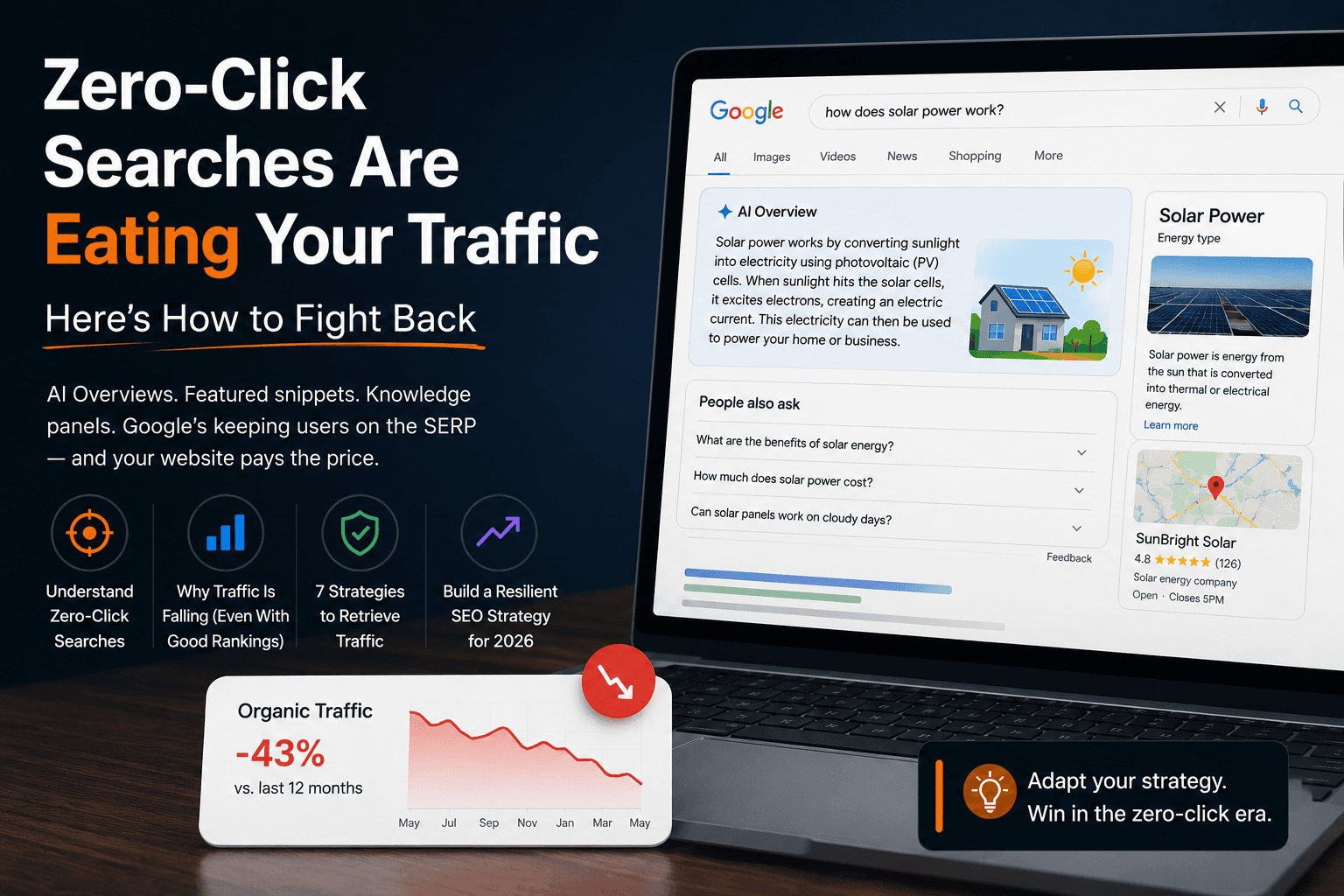
You open Google Search Console on a Monday morning, coffee in hand, and something looks wrong. Rankings are holding. Keywords are ranking. But your organic traffic is down - again. No algorithm update. No penalty. No obvious reason.
If this sounds familiar, you're not imagining it. And you're not alone.
The culprit is something most businesses haven't fully reckoned with yet: zero-click searches. Understanding why your website traffic is falling despite good rankings starts here.
What Are Zero-Click Searches?
A zero-click search happens when someone types a query into Google and gets their answer directly on the search results page without clicking through to any website.
It could be an AI Overview summarising an article, a featured snippet pulling a definition, a knowledge panel showing a business's hours, or a People Also Ask box answering a question in three lines.
The user got what they needed. Google kept them on Google. Your website never saw the visit.
This isn't new. Google has been building toward this for years. But with the rollout of AI Overviews across search results in 2024 and 2025, the scale has changed dramatically. Studies in early 2026 show that over 60% of Google searches now end without a single click to an external website.
For businesses that built their growth on organic search traffic, this is a serious and growing problem.
Why Is Website Traffic Falling Even With Good Rankings?
This is the question SEO teams and business owners are asking right now, and the answer requires an honest look at how search has changed.
Ranking on page one used to mean traffic. That equation is breaking down.
Here's why website traffic is falling even when you're ranking well:
1. AI Overviews are sitting above your result
Google's AI-generated summaries now appear at the very top of results for a growing range of queries, especially informational ones. Even if you rank in position one, an AI Overview above you is capturing attention before a user ever sees your link.
2. Featured snippets steal the click
When Google pulls a direct answer from your page into a featured snippet, it answers the question without the user needing to visit. You gave Google the content. Google kept the traffic.
3. Navigational and transactional searches are being absorbed
Knowledge panels, Google Maps listings, and shopping carousels are resolving queries that previously sent users to websites. Even branded searches are being partially absorbed.
4. Voice search delivers one answer, not a list
As voice-driven queries grow, the winner-takes-all dynamic gets sharper. Only one result gets read aloud. Everyone else gets nothing.
The uncomfortable truth: Google has become a destination in itself. Your content is feeding it. Your traffic is the cost.
The Scale of the Problem in 2026
To understand how to retrieve traffic and rebuild your organic strategy, you need to understand just how deep this problem runs.
Research from SparkToro and Datos, published in late 2024, found that Google search sends less traffic to the open web than at any point in the past decade. In the EU, where AI Overviews initially rolled out more cautiously due to regulation, some recovery was seen, but globally the trend is unmistakable.
For content-heavy websites such as blogs, publishers, and information sites, the drop in organic traffic has been severe. Some sites that relied on top-of-funnel informational content have seen traffic fall 30-50% in 12 months, with no recovery in sight using traditional SEO tactics.
For businesses, the message is clear: waiting for things to return to normal isn't a strategy. The landscape has changed permanently. The question is how to adapt.
How to Retrieve Traffic: 7 Strategies That Work in a Zero-Click World
Adapting to zero-click search doesn't mean abandoning SEO. It means evolving it and building alongside it rather than against it. Here's how to retrieve traffic and protect your growth.
1. Target bottom-of-funnel keywords
Informational queries like "what is X" and "how does Y work" are the most vulnerable to zero-click. Shift your keyword strategy toward transactional and commercial-intent searches like "best service for a specific use case" or product comparison queries that require nuance and trust.
2. Build content that AI can't summarise
The content that survives zero-click is harder to compress into a paragraph: original research, proprietary data, first-person case studies, detailed how-to guides with screenshots, and expert opinions that require context.
3. Win featured snippets strategically
Featured snippets can reduce clicks, but owning the snippet also puts your brand name in a prominent position. Structure content with clear questions, concise 40-60 word answers, and expanded detail below.
4. Diversify your traffic sources
Businesses that rely almost entirely on organic search are exposed. Build email, social, YouTube, podcast, paid search, and other channels in parallel so SEO is not your only growth lever.
5. Optimise for People Also Ask and related searches
People Also Ask boxes and related search features still drive clicks for the right content. Identify secondary questions around your core topics and build dedicated, well-structured answers for each.
6. Make email your primary owned channel
An email list doesn't depend on Google's algorithm and doesn't vanish with an AI Overview update. Pair your best content with a genuine reason to subscribe and build an audience Google can't take away.
7. Focus on brand search
As generic organic traffic erodes, branded search becomes more valuable. Build brand awareness through PR, partnerships, guest content, and social presence so more people search for you by name.
What Zero-Click Means for Your Content Strategy
Here's the reframe that changes everything: zero-click searches aren't purely a problem. They're also an opportunity if you understand them correctly.
Every AI Overview, featured snippet, and knowledge panel is a visibility moment. Your brand, name, and answer appearing in those formats means exposure even without the click. For businesses focused on brand building, this is genuinely valuable.
The mistake is measuring success by clicks alone. In a zero-click world, impressions, brand mentions, and assisted conversions matter more than they used to. Update your measurement framework accordingly.
The Kynosi Perspective: SEO Isn't Dead - It's Evolving
At Kynosi, we've watched this shift play out across client accounts and our own channels. The businesses that are thriving aren't the ones who abandoned SEO. They're the ones who evolved their approach faster than everyone else.
They stopped chasing volume keywords and started winning high-intent searches. They built content that AI references rather than replaces. They grew email lists that send consistent, algorithm-proof traffic to their site every week.
Zero-click searches are a structural shift in how the web works. Adapting to them isn't optional for businesses that want to grow. But with the right strategy, it's entirely possible, and the businesses that adapt fastest will pull further ahead of competitors who are still waiting for the traffic to come back on its own.
Final Thought: Stop Waiting. Start Adapting.
Understanding why website traffic is falling is the first step. Knowing how to retrieve that traffic and build something more resilient is what separates the businesses that grow from the ones that plateau.
The playbook has changed. The good news is that the businesses willing to update their thinking have a genuine edge right now because most of their competitors haven't.
Zero-click searches aren't going away. The question is whether you'll adapt before your traffic does.
Zero-click search has changed the relationship between rankings and traffic. Businesses that adapt their keyword strategy, build harder-to-replace content, diversify channels, and invest in owned audiences will be in a stronger position than those waiting for old traffic patterns to return.