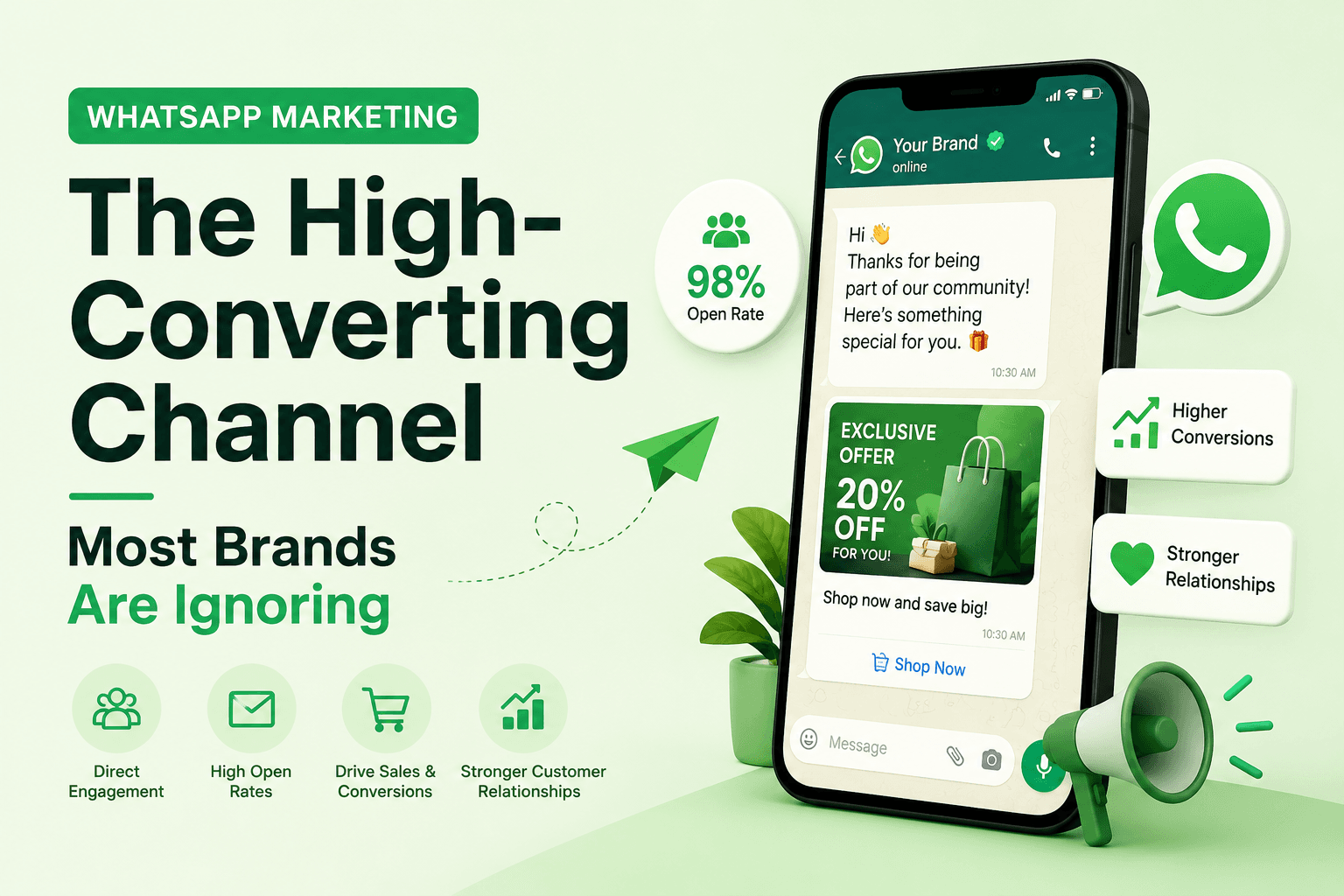
Your email lands in a tab no one checks. Your social post gets buried in 30 seconds. Your ad gets scrolled past before it fully loads.
But WhatsApp? WhatsApp gets opened.
Open rates above 90%. Response rates that beat email by a factor of three. A global user base of over 2 billion people who check the app multiple times a day. WhatsApp marketing isn't a future opportunity — it's a present one that the majority of brands are still walking past.
That changes today.
Why WhatsApp Is the Most Underused Marketing Channel in 2026
The irony of WhatsApp marketing is that everyone uses WhatsApp personally — and almost no brand uses it professionally. The app is where people talk to family, coordinate with friends, and make quick decisions. It's intimate, immediate, and trusted in a way that email and social simply are not.
For brands, that trust is an extraordinary asset. When a message arrives on WhatsApp, it doesn't feel like marketing — it feels like a conversation. And conversations convert.
Here's what the data shows:
1. 98% average open rate
WhatsApp messages achieve an average open rate of 98% — compared to 20–25% for email.
2. 3–5x higher response rates
Response rates on WhatsApp are 3–5x higher than email campaigns.
3. Superior conversion rates
WhatsApp-driven campaigns consistently outperform SMS, email, and social retargeting in head-to-head comparisons.
For businesses selling products, services, or consultations — especially in markets where WhatsApp is the primary communication platform — ignoring it isn't a neutral choice. It's leaving revenue on the table.
WhatsApp Channel Marketing: What It Actually Looks Like
WhatsApp marketing isn't just sending bulk messages. Done well, it's a structured, permission-based communication channel that spans the entire customer journey. Here's what WhatsApp channel marketing looks like in practice:
1. WhatsApp Business App (Small Teams)
For businesses just starting out, the WhatsApp Business App is free and gives you access to a business profile, automated greeting messages, quick replies, and a basic product catalogue. It's manually managed, which limits scale — but it's a genuine starting point.
2. WhatsApp Business API (Scaling Businesses)
For businesses ready to scale WhatsApp marketing seriously, the Business API allows broadcast campaigns, automated sequences, two-way CRM-integrated conversations, rich media messaging with buttons and carousels, and chatbot integration for 24/7 lead qualification. Platforms like WATI, Interakt, and Respond.io make this accessible without deep technical knowledge.
3. WhatsApp Channels (Broadcast Feature)
Launched by Meta in 2023 and now widely adopted, WhatsApp Channels allow businesses to broadcast updates to followers — similar to a newsletter, but inside WhatsApp. Followers can react and share but can't reply, keeping moderation simple. For brand updates, content drops, and flash promotions, this is fast becoming a powerful top-of-funnel tool.
How to Brand on WhatsApp: Building Presence That Converts
The question most businesses ask is: how to brand on WhatsApp without feeling spammy? The answer comes down to three principles — permission, value, and consistency.
1. Permission Is Non-Negotiable
WhatsApp marketing only works when people want to hear from you. Unlike email, WhatsApp is personal. Unsolicited messages don't just get ignored — they get reported. Every contact in your WhatsApp list should have explicitly opted in through a website form, checkout page, ad click-to-WhatsApp, or in-store QR code. The good news: people who opt in are highly engaged. The bar to subscribe is higher, which means the quality of the audience is better.
2. Value Has to Come First
The brands succeeding at WhatsApp for branding aren't leading with promotions. They're leading with value — exclusive tips, early access, useful content, order updates, personalised recommendations. A simple formula: for every promotional message, send two value messages. Keep the ratio generous and your unsubscribe rate stays low.
3. Consistency Builds the Brand
WhatsApp for branding works because it's consistent. Brands that show up regularly — weekly tips, monthly offers, real-time event updates — build a presence that feels like a relationship rather than a campaign. Tone matters too: WhatsApp is conversational, so formal corporate language underperforms. Write like a person, not a press release.
WhatsApp Marketing Across the Customer Journey
One of the most powerful things about WhatsApp marketing is its versatility across every stage of the funnel:
1. Awareness
Click-to-WhatsApp ads on Facebook and Instagram drive cold audiences directly into a conversation. Instead of landing on a form page, users land in a chat — frictionless, immediate, and personal.
2. Consideration
Automated sequences can nurture a prospect over days or weeks — sharing case studies, answering common objections, offering a free consultation, and building trust at a pace that suits the buyer.
3. Conversion
Cart abandonment flows, limited-time offers, and direct product recommendations sent via WhatsApp consistently outperform their email equivalents. The intimacy of the channel creates urgency without aggression.
4. Retention
Post-purchase care, loyalty rewards, and re-engagement campaigns keep customers in your ecosystem and drive repeat revenue. WhatsApp channel marketing for retention is one of the highest-ROI activities available to e-commerce and service businesses alike.
Real Results: What WhatsApp Marketing Delivers
Brands that have committed to WhatsApp marketing as a channel — not an experiment — are seeing results that outperform their other channels:
1. 45–65% cart recovery rates
E-commerce brands running WhatsApp cart recovery sequences report 45–65% recovery rates on abandoned carts.
2. 30% fewer no-shows
Service businesses using WhatsApp for appointment reminders see no-show rates drop by up to 30%.
3. 40–60% lower cost-per-lead
B2B companies using click-to-WhatsApp ads for lead generation report cost-per-lead 40–60% lower than equivalent LinkedIn campaigns.
4. 25–35% more repeat purchases
Retail brands with WhatsApp loyalty programmes see repeat purchase rates increase by 25–35%.
Common Mistakes That Kill WhatsApp Marketing Results
Even businesses that understand the opportunity make mistakes that undermine their results:
1. Skipping the opt-in process
Buying lists or importing contacts without consent violates WhatsApp's terms of service — and destroys the trust that makes the channel work.
2. Over-messaging
WhatsApp is high-attention. More than two to three messages per week without strong value justification leads to rapid unsubscribes.
3. Treating it like email
Long, text-heavy messages don't perform on WhatsApp. Short, conversational, mobile-first messaging does. Images, voice notes, and interactive buttons consistently outperform plain text blasts.
4. No two-way strategy
The biggest mistake brands make is broadcasting without ever creating space for conversation. Two-way engagement drives loyalty. One-way blasts drive unsubscribes.
Getting Started: Your WhatsApp Marketing Roadmap
If WhatsApp marketing is new to your business, here's a simple roadmap to launch effectively:
1. Set up your WhatsApp Business profile
Complete with logo, description, website link, and business hours.
2. Build your opt-in infrastructure
Website pop-ups, checkout opt-ins, QR codes, and click-to-WhatsApp ads.
3. Create your welcome sequence
A 3–5 message automated flow that delivers value immediately and sets expectations.
4. Plan your content calendar
Decide frequency, content mix, and promotion ratio before you send anything.
5. Choose your platform
If you're scaling beyond a few hundred contacts, invest in a proper WhatsApp API platform.
6. Measure and iterate
Track open rates, click rates, reply rates, and conversion. Optimise based on what the data tells you.
Final Thought: The Window Won't Stay Open
Here's the reality about WhatsApp marketing in 2026: it's still early enough that most of your competitors haven't built a real presence there. That gap is your advantage — but it won't last.
As more brands discover what WhatsApp channel marketing can do, the space will get more competitive and more expensive. The businesses that build their WhatsApp audience now — when acquisition is cheap and competition is low — will have a significant structural advantage over those who wait.
The channel that most brands are ignoring is the one that's converting best. The only question is how long you're willing to leave it to someone else.
WhatsApp marketing combines the reach of social, the intimacy of messaging, and the conversion power of direct communication. Brands that build this channel now — with permission-first lists, value-led content, and proper automation infrastructure — will outperform competitors still relying on email and social alone.