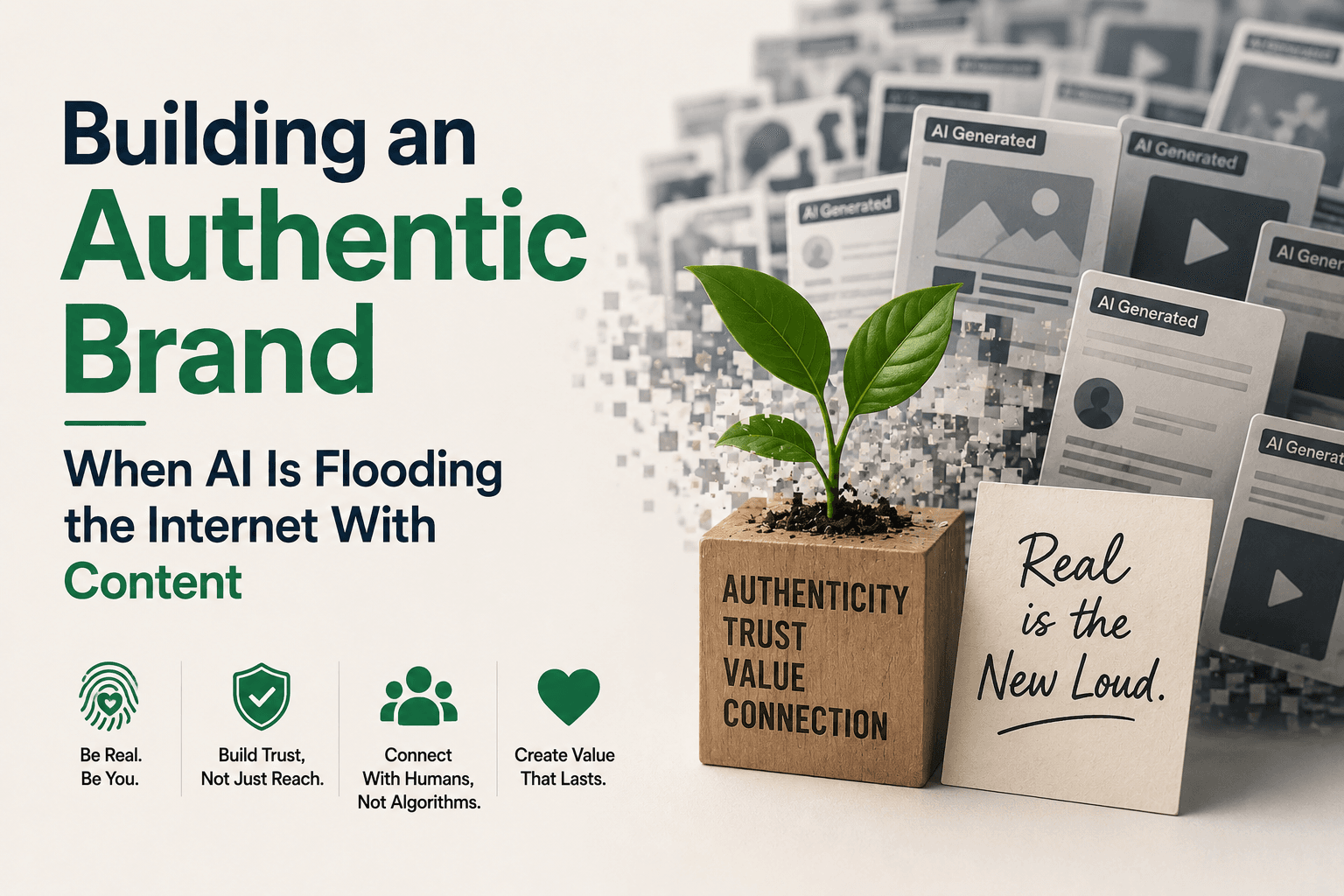
Open any industry blog today. Read three articles on the same topic. Notice something?
They sound the same. Same structure. Same phrasing. Same four takeaways wrapped in slightly different headings. The internet is filling up with content that's technically correct, reasonably well-written, and completely forgettable.
AI-generated content didn't create mediocrity — but it industrialised it. And for brands trying to build genuine trust with a real audience, this presents both a serious problem and a significant opportunity.
The problem: it's harder than ever to be heard above the noise. The opportunity: authentic branding has never been more valuable — precisely because it's become so rare.
What's Actually Happening to Brand Trust Right Now
Brand trust is in a strange moment. On one hand, consumers are more sceptical than ever — they've grown up with advertising, they recognise inauthenticity instinctively, and they have immediate access to reviews, comparisons, and alternatives. On the other hand, when a brand does earn genuine trust, the loyalty that follows is extraordinarily durable.
The rise of AI-generated content has accelerated this divide. Audiences are becoming better at sensing when content is manufactured versus when it reflects a genuine perspective. They may not be able to articulate exactly what makes one piece feel real and another feel hollow — but they feel the difference, and they act on it.
For digital branding in 2026, this means the rules have shifted. Volume used to be a competitive advantage in content marketing. Today, volume produced without voice is a liability. It trains your audience to stop paying attention.
Authentic branding isn't about rejecting AI. It's about ensuring that what you put out into the world represents something real — a genuine point of view, a distinct perspective, a human voice that AI can assist but can't manufacture.
The Problem With AI-Generated Content at Scale
To be clear: there's nothing inherently wrong with using AI tools to help create content. Every effective business uses tools to work faster. The problem isn't the tool — it's what gets lost when the tool replaces the thinking rather than supporting it.
AI-generated content tends to produce the consensus view. It aggregates what already exists, finds the middle of the distribution, and delivers something that's unlikely to be wrong — and equally unlikely to be memorable. It optimises for acceptability rather than distinctiveness.
Authentic branding requires the opposite. It requires taking positions. Saying things that not everyone will agree with. Sharing perspectives that come from actual experience rather than aggregated data. Telling stories that only your brand could tell.
When brands use AI to produce content at volume without injecting real perspective, they end up sounding like everyone else — which in a world drowning in AI-generated content, is the most dangerous place to be.
What Authentic Branding Actually Means in 2026
Authentic branding isn't about being raw, unpolished, or conspicuously 'human' in a way that's just another aesthetic choice. It's about the substance beneath the surface — the genuine beliefs, experiences, and perspectives that make your brand worth paying attention to.
Here's what it looks like in practice:
1. A Documented Point of View
The brands building the most durable brand trust right now are the ones with a clear, documented perspective on their industry. Not just 'we believe in quality' platitudes — actual positions on how things should be done differently, what's broken in the market, what most businesses get wrong. This point of view should be specific enough to exclude some people. If your brand position appeals to everyone equally, it resonates with no one deeply.
2. Original Stories No AI Can Replicate
The content most resistant to AI-generated competition is content that could only come from your brand. Client transformations with specific numbers and named outcomes. Behind-the-scenes decisions that show how you actually think. Failures and what you learned from them. Predictions based on what you're seeing in your own work. AI can write a guide to email marketing. It cannot write your specific account of why you fired your biggest client and what happened next.
3. Consistency of Voice Across Every Channel
One of the most effective digital branding moves a business can make is radical consistency of voice. The same tone, the same perspective, the same personality — whether it's a website headline, an Instagram caption, a sales email, or a WhatsApp broadcast. Most brands are inconsistent without realising it. Audiences notice this incoherence even when they can't name it — and it erodes brand trust at the subconscious level.
Digital Branding Strategies That Work Against the AI Tide
So how do you build and maintain authentic branding when the content landscape is saturated with AI-generated material? Here are the strategies that are actually working:
1. Invest in Proprietary Research and Data
Original data is the single most powerful differentiator in a world of AI-generated content. A survey of 500 customers. An internal analysis of what your best clients have in common. A trend report based on your own work. This content cannot be replicated because it doesn't exist anywhere else — AI can't generate data it doesn't have. Brands that publish original research consistently earn more backlinks, more media mentions, and more brand trust than those producing even the most polished general content.
2. Build Around Faces, Not Just Logos
The businesses with the most authentic branding in 2026 are often the ones that have put real people front and centre. A founder writing a personal newsletter. A team member sharing their expertise on LinkedIn. A face in the video rather than a stock illustration. AI-generated content has made faceless content cheap and ubiquitous. Human-fronted content is, by definition, something AI cannot produce.
3. Take Public Positions
The safest-seeming strategy for a brand is to avoid controversy — but in a content landscape full of AI-generated blandness, the safest-seeming strategy is actually the riskiest. Brands with no strong opinions are invisible. Authentic branding requires taking positions on things that matter to your audience. 'Most agencies are doing X wrong' is more memorable than 'we take a holistic approach.'
4. Prioritise Depth Over Frequency
Publishing less, but with more depth, often builds stronger brand trust than publishing frequently with average quality. A long-form piece that represents genuine expertise and a distinctive point of view will earn more trust, more shares, and more inbound than five average posts that could have been generated in minutes. In an era of AI-generated content abundance, depth is scarcity — and scarcity commands attention.
5. Create Community, Not Just Content
The brands most protected from AI-generated content commoditisation are the ones that have built genuine communities around their work. Email newsletters with distinct voices. Online communities where customers connect. Events, virtual or physical, that bring your audience into real relationship. Community is the ultimate authentic brand asset because it can't be scaled artificially.
How AI Can Support Authentic Branding (Without Replacing It)
Used correctly, AI is an extraordinary tool for authentic branding — as long as it's supporting your thinking rather than replacing it.
Where AI helps: research, outlining, editing, formatting, repurposing long-form content into multiple formats, generating first drafts that you then rewrite in your voice.
Where AI hurts: generating the perspective itself, deciding what positions to take, creating the original stories, developing the point of view that makes your brand distinctive.
The healthiest relationship with AI-generated content for brand-building is one where AI does the heavy lifting on production and you do the heavy lifting on thinking. The ideas, the angles, the voice, the opinions — those have to come from somewhere real. AI can help you say them better. It can't have them for you.
Final Thought: Authenticity Is Now a Strategic Asset
In a world saturated with AI-generated content, authentic branding is one of the last genuine competitive advantages available to most businesses. Brand trust, once built, is extraordinarily durable. It converts better, retains longer, and generates more referrals than any paid channel.
The brands investing in authenticity now — when most of their competitors are racing toward AI-generated volume — are building something that will be very hard to replicate later.
The internet is full of content. What it's short on is brands worth trusting.
Be one of those.
Authentic branding in 2026 is not a soft, feel-good strategy — it's a hard competitive advantage. In a landscape flooded with AI-generated content, the brands that stand for something real, speak with a genuine voice, and build actual trust with their audience will outperform everyone racing toward volume.